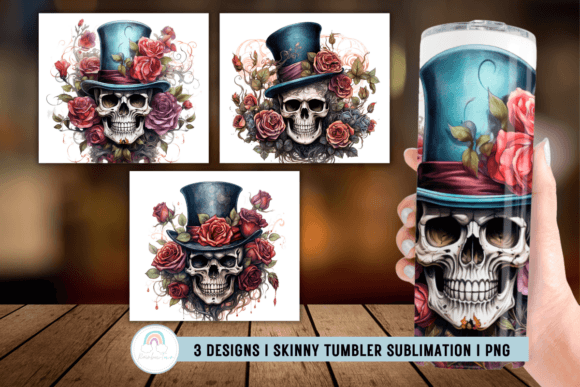
Halloween Skull Tumbler Sublimation
First Impression: Bold, Playful, and Instantly Recognizable
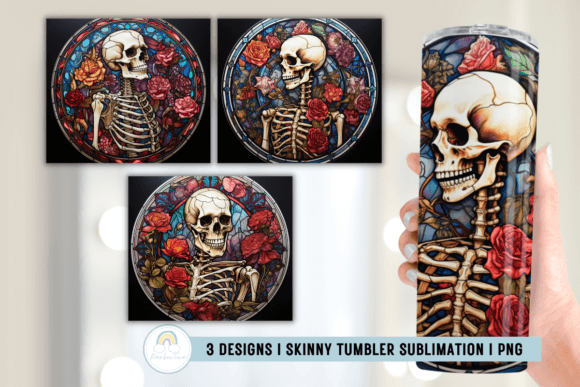
When I opened the Halloween Skull Tumbler Sublimation files, my eye went straight to the skull’s expressive asymmetry—the slightly tilted jaw, the hollow eyes with subtle inner shading, and the playful bat-wing motif framing the top. It doesn’t scream “scary.” It whispers “spooky-chic,” which is exactly what modern craft businesses need for seasonal merchandise that sells beyond October 31st. As a designer who’s stitched hundreds of holiday motifs—from candy corn to cauldrons—I immediately saw how this skull translates beyond sublimation: its clean silhouette and balanced negative space make it a strong candidate for machine embroidery design, especially on structured items like tote bags, aprons, or embroidered patches.
Real-World Use Case: A Boutique Tote Bag Launch
Last week, I prepped a small-batch run of canvas tote bags for a local gift shop’s Halloween collection. Instead of starting from scratch, I pulled up Halloween Skull Tumbler Sublimation to test its adaptability. I resized the central skull motif (not the full tumbler wrap) into a 4.2" wide embroidery file and digitized it for satin-stitched outlines with light fill stitch in the eye sockets. On natural canvas with medium-weight cutaway stabilizer, the result was crisp, legible, and tactile—no bleeding, no thread nesting. Customers responded well: one even asked if it came in a matching baby onesie version. That tells me this isn’t just a tumbler graphic—it’s flexible design assets with cross-product potential.
Where It Shines in Embroidery Projects
- Custom apparel: Works beautifully on sweatshirt cuffs, back yokes, or chest pockets—its moderate detail holds up without overwhelming fabric texture.
- Tote bag design & aprons: The skull’s vertical emphasis reads clearly at 3–5" tall, even from across a craft fair booth.
- Embroidered patch: Clean outer edges mean sharp laser-cut or heat-seal backing won’t eat into key details.
- Holiday embroidery for baby items: Simplified enough for onesies or burp cloths when scaled down to 2.5", but still retains personality—no “cute-but-generic” energy here.
- Commercial embroidery: Its balanced stitch density avoids excessive jump stitches, keeping production time predictable for small shop owners.
Where to Proceed With Care
Halloween Skull Tumbler Sublimation wasn’t built for micro-detail work—and that’s fine. But as an embroidery designer, I’ll flag where caution helps protect your finished product’s integrity:
- Small hoop sizes (under 3"): The skull’s inner highlights and wing contours risk becoming indistinct. Stick to 3.5" minimum for clarity.
- Textured or stretchy fabric: Avoid heavy terrycloth or ribbed knit unless you add tear-away + cutaway stabilizer combo—those wings catch easily on loops.
- Dark fabric: The original PNG has transparent background, so white or light thread is essential for contrast. Always test thread colors on scrap first.
- Curved surfaces (caps, hats): The full wrap layout won’t translate directly—you’ll need to isolate and reposition the skull motif manually for proper cap front placement.
- Frequent-wash items (tea towels, baby clothes): Reinforce satin stitch edges with a tight running stitch border if durability is critical.
What It Adds to Your Handmade Product & Brand
This isn’t just decoration—it’s quiet brand reinforcement. When customers see Halloween Skull Tumbler Sublimation stitched cleanly onto a linen pillow cover or organic cotton sweatshirt, they register craftsmanship, intention, and seasonal relevance—not just “a skull I found online.” For Etsy sellers and small shop owners, that perception lifts perceived value and supports pricing confidence. I’ve watched buyers linger longer on listings where embroidery feels considered, not slapped on—and this design encourages that feeling. It also plays well with cohesive collections: pair it with minimalist pumpkin or ghost motifs (same line weight, same visual weight), and you’ve got scalable holiday embroidery for your entire craft business.
Practical Designer Notes Before You Stitch
- Test the design on scrap fabric *first*—especially if using textured or dark materials.
- Review stitch density in your embroidery software: avoid overloading fill areas on lightweight fabrics.
- Confirm hoop size compatibility—this motif scales well, but don’t force it into a 2.5" hoop without simplifying details.
- Inspect small corners (like wing tips) in your digitizing preview—they’re prone to skipped stitches on older machines.
- Run black-and-white mockups: does the skull retain impact without color? It should.
- Compare light and dark fabric backgrounds digitally *before* stitching—transparency means you control contrast entirely.
- Use appropriate stabilizer: cutaway for knits, tear-away for stable wovens, and always secure fabric tightly in the hoop.
- Verify licensing terms before selling finished items—this is a digital embroidery file derived from a sublimation graphic, so commercial use rights must be confirmed with the seller.
Final Thought: A Seasonal Staple, Not a One-Off
Halloween Skull Tumbler Sublimation earns its place in my working library because it bridges categories: it began as Graphics for Crafts, but functions as reliable embroidery project fuel. It’s not overly complex, yet never boring; not too literal, yet unmistakably Halloween. For makers building a recognizable aesthetic—or launching their first holiday collection—it offers consistency, scalability, and that rare quality: instant recognition without sacrificing handmade warmth. Whether you’re stitching a single personalized gift or prepping 50 embroidered patches for your Etsy shop, this skull doesn’t distract from your craft—it quietly elevates it.