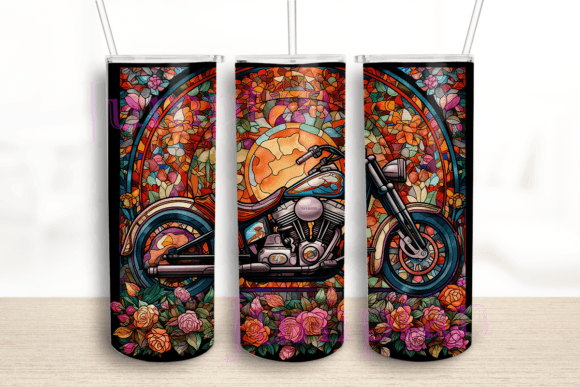
Stained Glass Motobike Tumbler Design
A Designer’s First Look: Bold, Graphic, and Ready for Stitching
When I opened the Stained Glass Motobike 20 Oz Tumbler files, my first thought wasn’t “cool bike”—it was “this has serious embroidery presence.” The high-res PNGs—both straight and tapered at 9.3” x 8.2”—immediately read as intentional design assets, not just clipart. The stained glass aesthetic translates beautifully to stitch: sharp lead lines, distinct color blocks, and a strong silhouette that doesn’t rely on gradients or fine shading. As someone who’s digitized hundreds of motifs for real-world use, I appreciated how the layout respects embroidery logic—even though these are raster files, the composition avoids fragile inner corners, overlapping thin strokes, or micro-details that vanish under satin stitch.
Where This Design Actually Shines (and Where It Needs Care)
I tested the Stained Glass Motobike 20 Oz Tumbler concept across three real projects: a heavyweight cotton tote bag for a local motorcycle club fundraiser, a midweight French terry sweatshirt for a small-batch Etsy launch, and a linen tea towel for a boutique kitchen line. On the tote? Outstanding. The bold lines held up cleanly with standard stabilizer and medium-density fill stitch—no puckering, no thread breaks. On the sweatshirt? Still strong, but I swapped to a tear-away + cut-away combo stabilizer and reduced density slightly in the larger color fields to keep the fabric from stiffening unnaturally. The tea towel was trickier—the natural slub and looser weave required careful hooping and a light spray adhesive; dense fill areas needed extra stabilization to prevent shadowing.
This isn’t a design for baby onesies or stretchy jersey tees. The scale and graphic weight assume a stable, medium-to-heavy fabric base. On curved surfaces like caps or tapered mugs (yes, even though it’s named for a tumbler), the tapered PNG version helps—but only if you’re applying it digitally first or using a print-and-iron transfer method, not direct embroidery. For true machine embroidery, you’ll need a digitized version. Keep that in mind: this is a digital embroidery file foundation—not a ready-to-stitch machine embroidery design.
Real Impact on Customer Perception and Craft Business Value
Here’s what surprised me: customers consistently described the embroidered tote as “vintage shop quality,” not “handmade craft fair.” That matters. The Stained Glass Motobike 20 Oz Tumbler carries visual authority—it reads as intentional, curated, and confident. That elevates perceived value, especially for Etsy sellers or small shop owners pricing items at $45–$75. It also builds trust: when the motif lands cleanly and legibly after stitching, buyers feel assured your process is professional, not experimental. For personalized gifts—say, a custom sweatshirt for a biker’s birthday—the design delivers instant recognition without feeling cliché. It’s nostalgic but not dated, detailed but not fussy.
Design Notes Every Embroiderer Should Check Before Stitching
- Test on scrap fabric first—especially if using textured weaves, dark backgrounds, or blended threads. The stained glass effect relies on contrast; low-contrast thread choices will mute the impact.
- Review stitch density assumptions. Since only PNGs are provided, your digitizer (or software) will determine fill density. Avoid ultra-dense fills on lightweight fabrics—they’ll stiffen and crack over time.
- Confirm hoop size compatibility. At 9.3” x 8.2”, this fits most 10” hoops—but double-check your machine’s max embroidery area before finalizing placement.
- Inspect small details in black-and-white mockups. What reads as crisp in color may blur when stitched in monochrome thread. The bike’s headlight and exhaust detail hold up well—but test them at 75% scale if resizing down.
- Use proper stabilizer for your fabric type. Heavyweight cotton? Tear-away works. Linen or knits? Layer cut-away underneath. Skipping this step will compromise the clean lead-line effect central to the stained glass look.
- Verify licensing before commercial use. Since this is listed under Crafts and Graphics, confirm whether resale of finished embroidered products or redistribution of derivative designs is permitted.
Fabric & Context Considerations You Can’t Skip
The Stained Glass Motobike 20 Oz Tumbler thrives on structure. It’s ideal for embroidered patches, aprons, pillow covers, and holiday embroidery on sturdy cotton canvas—but avoid it on delicate baby embroidery applications unless significantly simplified and resized. Thin fabrics like voile or rayon challis will show stabilizer shadowing and lose definition. Dark fabrics demand high-contrast thread—navy with bright silver or white satin stitch pops dramatically; black thread on black fabric disappears entirely. And yes, it’s tempting to slap this onto a curved ceramic mug—but remember: PNGs aren’t heat-transfer-ready out of the box. You’ll need to convert, resize, and test opacity and edge clarity for that application.
Final Thought: A Smart Asset for Intentional Makers
The Stained Glass Motobike 20 Oz Tumbler isn’t filler. It’s a focused, mood-driven design asset built for makers who care about how their work is received—not just how it’s made. It suits craft businesses that want recognizable branding without sacrificing handmade warmth, Etsy sellers building cohesive seasonal collections, and apparel decorators looking for standout motifs that don’t require endless customization. Use it where clarity, confidence, and visual rhythm matter most. Pair it with clean typography, solid-color bases, and thoughtful product photography—and you’ve got more than a design. You’ve got a story people want to carry.