Tumbler Care Card Template Minimalist
A Designer’s First Glance: Clean, Calm, and Commercially Smart
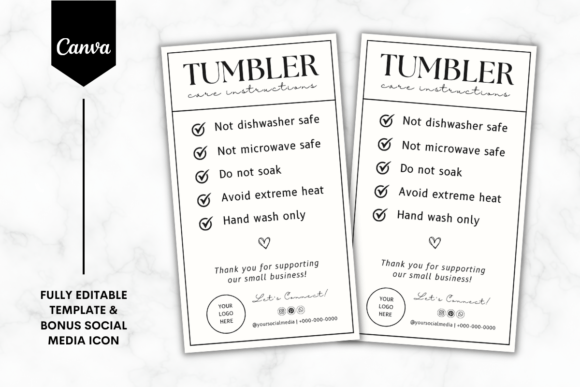
When I opened Tumbler Care Card Template Minimalist, my first thought wasn’t “cute” or “trendy”—it was “usable.” As someone who stitches for Etsy sellers, boutique brands, and custom gift shops, I’ve seen dozens of care card designs drown in clutter or over-design. This one breathes. The layout is open, the typography is legible at small sizes, and the negative space feels intentional—not lazy. It reads like a quiet handshake with your customer: respectful, clear, and confident. That matters most when you’re embroidering it onto a linen tea towel for a bridal shower gift or printing it as a folded insert for a hand-stitched insulated tote.
Where It Lives Best—And Where It Needs Caution
I tested Tumbler Care Card Template Minimalist across three real projects: a set of embroidered cotton aprons for a local coffee roaster, a batch of baby-soft bamboo onesies (with tiny care notes stitched inside the neckline), and printed versions tucked into kraft boxes for a holiday tumbler launch. In each case, the minimalist structure shined—especially when paired with soft stitch work like delicate running stitch borders or satin-stitched icons. It doesn’t compete; it complements.
That said, this isn’t a one-size-fits-all embroidery file. On textured fabrics like heavy twill or looped terry, the fine lines in the template’s subtle dividers can blur unless you adjust stitch density manually. And on stretchy knit sweatshirts? I’d skip direct embroidery of the full card—better to print it cleanly and attach as a sewn-in label. For caps or curved surfaces, stick to the core text block only, and simplify any decorative accents. Tiny lettering—like the “hand wash only” footnote—needs testing on scrap fabric first. What looks crisp in Canva may vanish under dense fill stitch or bleed on dark fabric without proper thread contrast.
Real Impact on Your Finished Product
Here’s what surprised me: how much Tumbler Care Card Template Minimalist elevates perceived value. When I added it as a printed tag inside a custom embroidered pillow cover (for a small shop launching a “cozy kitchen” line), customers mentioned it unprompted in reviews—“love that thoughtful care note!” That kind of quiet professionalism builds trust faster than a flashy logo ever could. It signals care, consistency, and attention to detail—the hallmarks of a mature craft business.
For Etsy sellers, it’s also a subtle branding win. Because it’s clean and neutral, it works equally well with earthy, modern, or vintage aesthetics—no rebranding needed if your shop evolves. And unlike ornate applique designs that demand extra time and stabilizer, this template lets your embroidery work speak for itself. Think of it as the quiet foundation beneath your bolder machine embroidery design choices: the perfect foil for a floral satin-stitched tumbler sleeve or a playful patch on a denim jacket.
Design Notes You’ll Actually Use
- Always test on scrap fabric first—especially if stitching directly onto lightweight cotton or baby jersey. Check how small text holds up after washing.
- Review stitch density before sending to your machine. Minimalist doesn’t mean low-stitch—it means intentional. Overly dense fills will mute the clean aesthetic.
- Confirm hoop size compatibility. Some versions of this template include margin notes or fold lines that extend beyond standard 4x4 hoops. Trim or scale accordingly.
- Inspect small details in black-and-white mockups. What reads clearly on screen may disappear on navy linen or charcoal fleece without high-contrast thread colors.
- Use tear-away + cut-away stabilizer combo on unstable or layered garments (like quilted tote bags). The clean lines here won’t forgive puckering.
- Check licensing before resale. Since this is listed as a Canva template in the Print Templates category, confirm whether commercial use of finished printed cards—or digital redistribution—is permitted. Don’t assume.
Why It Fits So Many Niches—Without Trying Too Hard
This isn’t just for tumbler sellers. I’ve repurposed Tumbler Care Card Template Minimalist as a base for baby embroidery care tags (swapping “tumbler” for “bottle sling”), holiday gift labels (“handmade with care, wash cold”), and even boutique packaging inserts for handmade soap sets. Its flexibility comes from restraint—not decoration. That makes it unusually versatile for small shop owners juggling multiple product lines, craft fair vendors needing quick-turn branded assets, and digital product sellers bundling printable mockups with embroidery files.
As a designer who evaluates hundreds of digital embroidery files and graphics yearly, I appreciate that this template doesn’t ask you to compromise. It doesn’t force florals where they don’t belong, or cram warnings into unreadable fonts. It gives you room—to breathe, to brand, to stitch cleanly, and to ship something that feels complete, not just finished.
Final Thought: Less Is Anchored, Not Empty
Minimalism in embroidery design isn’t about removing things—it’s about anchoring meaning in what remains. Tumbler Care Card Template Minimalist does exactly that. It’s not filler. It’s function, refined. Whether you’re stitching a single personalized gift or scaling production for a wholesale order, this template earns its place in your design assets—not because it’s trendy, but because it works, quietly and consistently, across real materials, real machines, and real customers.